Serving Downriver, Canton, Troy & Metro Detroit

The most expensive mistake in real estate happens before the sign goes in the yard.

Get a personally reviewed valuation range and a positioning strategy for your home — so we price to create demand, not to sit and get marked down.

Free. You book a 20-minute call, the Diagnostic Read. We build the report for your address before we talk, and you keep it either way. No listing agreement.

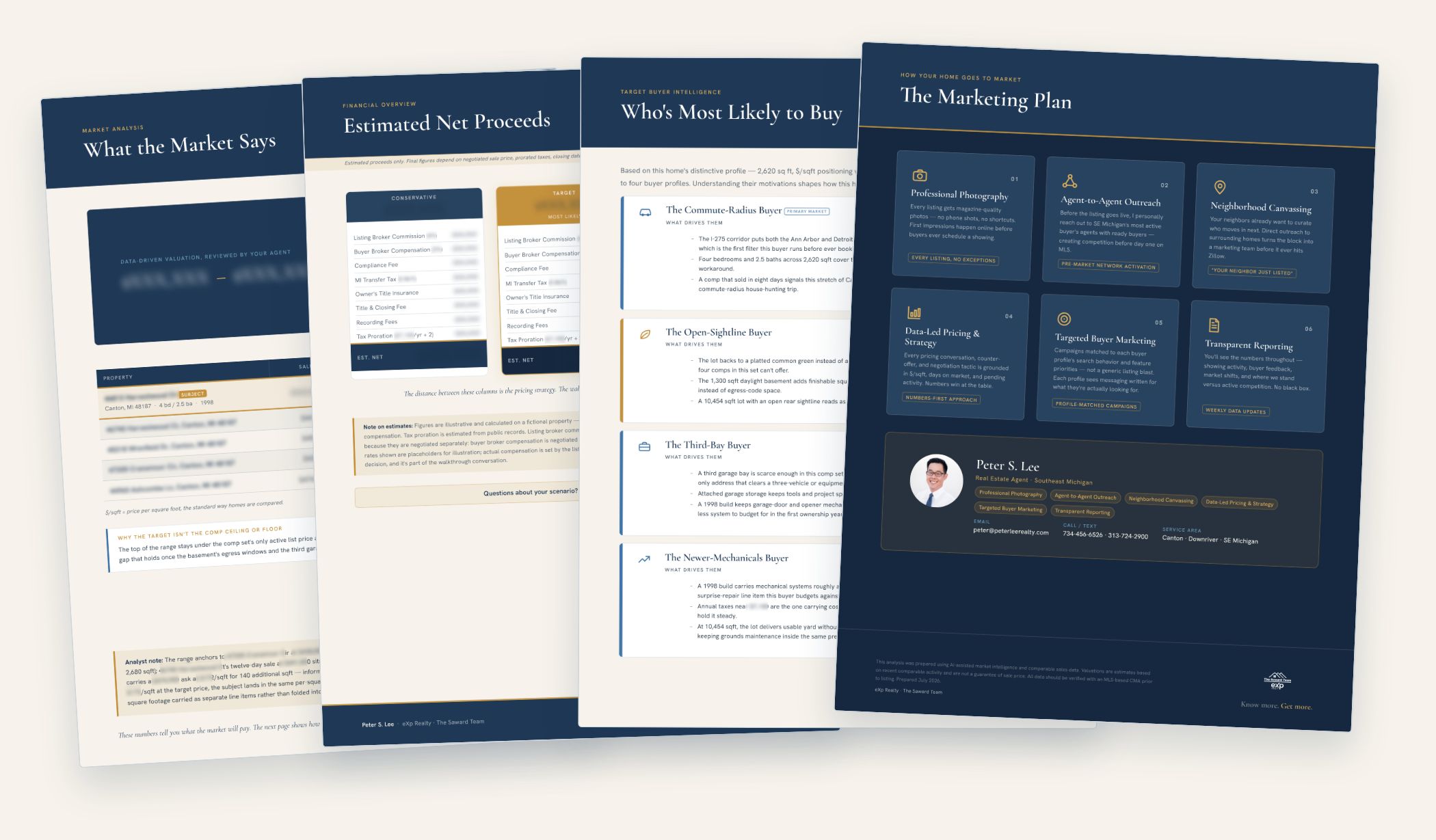
Four pages from the printed Listing Blueprint, fanned in order: the valuation, the net proceeds scenarios, the buyer page, and the six-part marketing plan. Sample figures are deliberately out of focus.
  • Valuation range, personally reviewed, in writing
  • Comps personally selected
  • 3,000+ transactions closed as a team

An overpriced listing doesn’t just sit. It gets weaker.

A new listing gets its most serious buyer attention early — that first window is when the right buyers are watching.

Price above the market and that window passes quietly. Few offers, or none. Then the correction goes public: buyers and their agents see the cut, see the days on market, and adjust what they offer accordingly.

Buyers don’t negotiate against your price. They negotiate against your price history.

Pricing is a positioning decision, and the first price carries the most leverage you’ll have. That’s why we treat it as the single most important call in the entire sale.

One report. Four answers.

The Listing Blueprint is a documented analysis of your home — prepared by us, personally reviewed, in writing.

  1. Valuation Range

    Not a single hopeful number. A defensible range, built on comparable sales we select and review personally — active, pending, and closed.

  2. Three Proceeds Scenarios

    What you’d actually walk away with at three realistic pricing positions, every cost itemized line by line.

  3. What Buyers Pay For

    What buyers in your price range are comparing your home to, and which of its features they’ll weigh first. Positioning starts with the property.

  4. Six-Part Marketing Plan

    How the home is presented, where it’s placed, and in what order — mapped to what buyers are comparing, not blasted everywhere and hoped for.

Sale price is a headline. Net is the story.

Every proceeds scenario in the report itemizes the same lines, at three pricing positions.

The proceeds page, line by line

Line itemConservativeLowTargetOptimisticHigh
Sale price
Estimated payoff balance
Listing broker commission
Buyer broker compensation (if offered)
Compliance fee
Transfer tax
Owner’s title insurance
Title & closing fee
Recording fees
Prorations & misc.
Estimated net to you

Illustrative excerpt; your report is prepared for your property and the market at the time of analysis. Buyer broker compensation is negotiated independently and is not published by the MLS.

What does asking for more actually buy you?

Pick a pricing position and see what typically happens next — time on market, the odds of a public price cut, and how buyer attention shifts. These are typical market patterns, not a prediction for your home. The report is where your home’s specifics come in.

Pricing Position Monitor

Typical market patterns, illustrative

Typical days on market
Likelihood of a reduction cycle
Serious buyer attention at launch

A longer bar means more of that measure. Bars show relative patterns, not measurements — illustrative market tendencies, not data for any specific home.

The simulator shows the pattern. The report shows your home.

How the report gets made.

Know more. Get more. That’s the whole model.

  1. Comps, personally selected.

    Comparable sales are judgment calls. We make them ourselves — active, pending, and closed — because the comp set decides whether every number after it means anything.

  2. Analysis, systematized.

    The valuation range, scenario math, and cost stack are run the same way on every report, so nothing gets missed and nothing gets rounded away.

  3. Reviewed personally, every time.

    No report goes out without being read the way you’ll read it: line by line. Then we walk you through it live on the Diagnostic Read.

Peter S. Lee

The person who reviews your report is the person on your call.

Peter S. Lee

REALTOR® · The Saward Team · eXp Realty

Fair questions.

Isn’t this just a CMA with a nicer cover?

A CMA estimates value from comparable sales, and this report starts there too. Then it adds the comps shown, three itemized proceeds scenarios, what buyers in your price range are comparing your home to, and a marketing plan — in writing, so you can hold us to it.

How accurate is it?

The comps are judgment calls, and we make them personally. The analysis runs through our system, which is AI-assisted, and every report is personally reviewed before it reaches you. Accuracy is the product; we don’t outsource it.

What does it cost?

Nothing. No fee, no listing agreement, no obligation.

What happens on the 20-minute call?

We call it the Diagnostic Read. You pick a time, and before we talk we build the report for your address. On the call we walk you through the range, the three proceeds scenarios, and the marketing plan. You keep the report either way. If your town has one, you’ll get The First Look by email before the call: last month’s numbers, on one page.

Do I have to list with you to get it?

No. The report is yours either way. Our bet is that the difference between a real analysis and a guess speaks for itself — but that’s our bet to make, not your obligation.

I’m not selling for another year. Too early?

Earlier is better. Knowing your range and your positioning options now means every decision between here and listing day gets made with real numbers.

Price it right the first time. There is no second first impression.

A personally reviewed valuation range, three itemized scenarios, and a positioning strategy — in writing, before the sign goes in the yard.

Free. You book a 20-minute call, the Diagnostic Read. We build the report for your address before we talk, and you keep it either way. No listing agreement.